Tuesday, April 12, 2011
Houston Foodie is now J.C. Reid, Texas
I have discontinued the Houston Foodie blog and transitioned everything to my personal blog at J.C. Reid, Texas. All of the content here is duplicated there, and all future blog posts will be available at that site. Although most of my writing will continue to be about food, I'll be branching out to other topics, especially travel writing. The new blog allows for more flexibility in writing topics beyond just food. See you there!


Monday, March 21, 2011
The Truth About Neapolitan-style Pizza
My waiter, a young man in his twenties wearing a dirty apron that sheathed a prodigious belly usually seen on men some twenty years older, was the model of indifference.
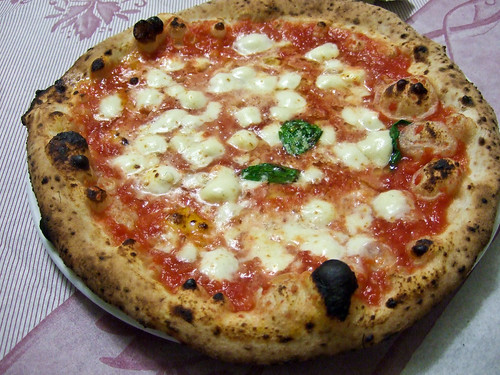
Pizza Margherita at Di Matteo in Naples, Italy
He spoke no English, and as I pointed to the menu to place my order for a pizza, he never looked up from his order pad. The dining room was dim and dusty — this restaurant had been around since 1936 — with mountainous piles of fetid, decomposing garbage just outside the front door. A few feet away on the adjoining street, cars and motorbikes competed in a diabolical contest to see who could lean on their horns the longest and loudest. When the pizza arrived, it was small (by American standards), misshapen, unsliced, charred all around and sparse on the toppings. This was the best pizza I'd ever had, in the best pizza joint I'd ever been to.
Read More...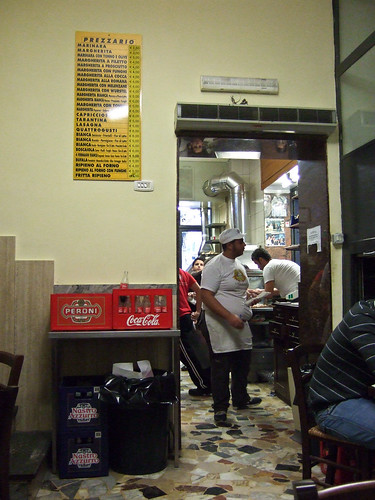
Di Matteo pizzeria in Naples, Italy
I was in Naples, Italy. The pizza joint was Antica Pizzeria e Friggitoria di Matteo, or just Di Matteo for short. It's located on Via dei Tribunali, a narrow, claustrophobic main thoroughfare that boasts several of the oldest pizzerias in the world. I was here to find out why Neapolitan pizza, or Pizza Napoletana, is considered by many to be the best and most authentic style of pizza.
There are many different "styles" of pizza. If you grew up in the U.S., you're probably most familiar with the "New York-style" pizza; basically a large, round "pizza pie" with a spongy crust that's topped with any number of ingredients and cooked in a commercial gas oven. In New York City you often buy this pizza "by the slice" from guys with names like Sal or Carmine. Another style from New York is the "coal-fired" pizzas made famous in joints like Lombardi's and Grimaldi's. More recently, authentic "Neapolitan-style" pizza — what has historically been known has Pizza Napoletana — has gained popularity in the U.S.
What's so special about Pizza Napoletana? Like many Italian foods, it boils down to history and taste. With regard to taste, Pizza Napoletana is the essence of simplicity; a few high quality ingredients combined and cooked in such a way to create a whole greater than the parts. The iconic version of Pizza Napoletana is the Margherita. A charred crust, thin in the middle and thicker around the edges, fragrant of yeast and bread, combines with the acidity of the tomato sauce and the richness of the Mozzarella di Bufala cheese, and then sprinkled with sea salt and fresh basil leaves. The pizza is baked in a wood-fired oven at 900 degrees for 60-90 seconds.
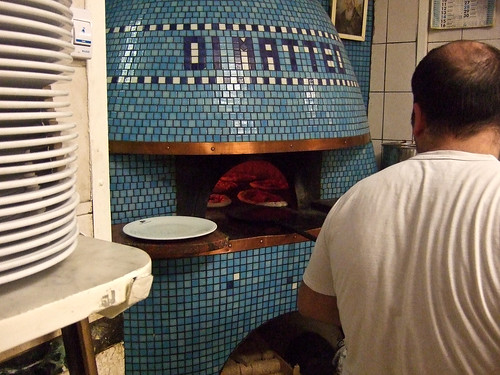
Wood-fired pizza oven at Di Matteo
The history of pizza is long, but suffice it to say that mankind has been slathering ingredients on top of baked dough for thousands of years. Of course, pizza is most often associated with Italy, particularly the city of Naples. Pizza Napoletana dates back to the early 1700s (corresponding to the introduction of tomatoes in Italy), and the recipe of the iconic Margherita pizza to the early 1800s. The name was established in 1889 when the Queen of Italy, Margherita of Savoy, visited Naples and was presented with a pizza made with ingredients featuring the colors of the Italian flag: red tomatoes, white cheese and green basil. There is still a pizzeria in Naples today — Pizzeria Brandi — that traces its origins to the pizzaiolo (pizza maker) Raffaele Esposito who is credited with preparing the pizza for the Queen.
So for pizza connoisseurs, true Pizza Napoletana is the gold standard of pizza styles, both in taste and history. But for those of us who aren't pizza experts, how do we tell when Pizza Napoletana is "real" and not "imitation?" Can we get real Pizza Napoletana in the United States.? In Texas? Who decides what's real and what's fake? Is real always better than fake?
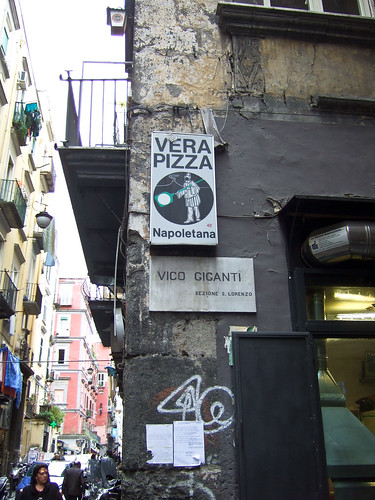
Vera Pizza Napoletana certification plaque at Di Matteo
The short answer is: yes, true Pizza Napoletana is (obviously) better than versions that use lower quality ingredients or shortcuts in the preparation. And there is a system in place to ensure that we as consumers get the real deal. And you can get it in Texas. The story of "true" Pizza Napoletana begins in Naples in 1984 with the formation of the Associazione Verace Pizza Napoletana ("Association for True Neapolitan Pizza").
The AVPN is a trade association tasked to promote and defend the true Pizza Napoletana. Among other activities, it sets guidelines for the ingredients and preparation of true Pizza Napoletana, and certifies that restaurants and pizzaioli are properly trained in those guidelines. A pizzeria that successfully acquires certification can display a "Vera Pizza Napoletana" plaque as a way to let consumers know that it makes the real Pizza Napoletana. Furthermore, in February 2010, The European Union granted Pizza Napoletana legal status as a Specialità Tradizionale Garantita (Traditional Specialty Guaranteed). This is a type of trademark that prevents "fake" or imitation makers of Neapolitan-style pizza (which may be of inferior quality) from claiming they produce true Pizza Napoletana.
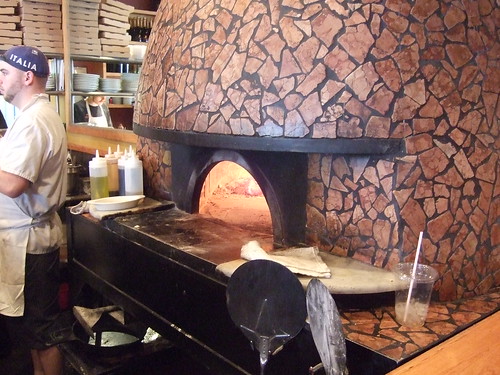
Wood-fired pizza oven at Dough Pizzeria in San Antonio
Here in the U.S., the AVPN has established an organization known as VPN Americas as the official delegation for true Pizza Napoletana. Based in California, it follows the exact same guidelines as the Naples association, and is responsible for certifying pizzerias and pizzaioli in the U.S. Currently there are over 40 pizzerias certified as Vera Pizza Napoletana in the United States.
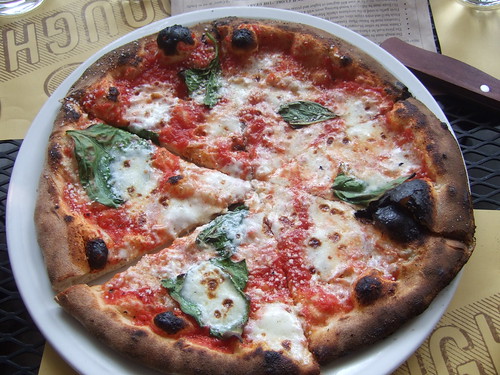
Pizza Margherita at Dough Pizzeria
In Texas, there are three VPN certified pizzerias: Cavalli Pizzeria in Irving, and Dough Pizzeria and Luciano Pizzeria in San Antonio. Dough is perhaps the most well-known Vera Pizza Napoletana (VPN) restaurant in Texas, with a loyal clientele and new plans to expand to Dallas. In my experience, Dough's "Margherita STG" pizza is the closest you will get to the real thing in Texas. In Houston, Chef Michael Kramer of The Tasting Room Wine Cafe has completed VPN training in California. The Tasting Room CityCentre location has a new wood-fired oven, and although the restaurant itself is not yet VPN certified, it is producing pizza Margherita in the tradition of true Pizza Napoletana.
It's a unique combination of globalization and legally-protected local food traditions that allows the spirit and flavor of true Pizza Napoletana to be made available worldwide. Obviously there are many pizzerias and styles of pizza throughout the world that are of a high quality and don't necessarily need a certification. But for those of us who are interested in the traditions and history of what we eat and cook, Vera Pizza Napoletana is a great resource to make sure we get the real deal when it comes to Neapolitan-style pizza.
This blog entry was originally posted 14 March 2011 on the www.29-95.com website.
Tuesday, March 1, 2011
Who's afraid of a little haggis?
This is a story about haggis, a dish traditionally associated with the cuisine of Scotland. There are many myths, legends, rumors, and even poems associated with haggis. But most importantly, haggis is a delicious and nutritious dish.
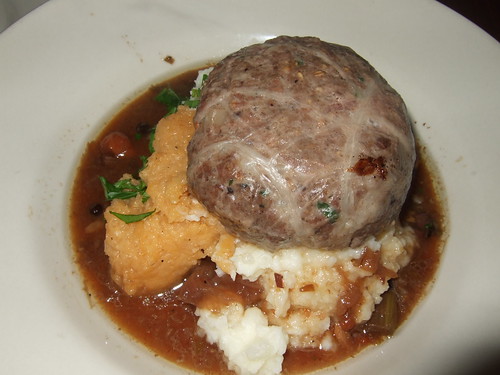
Haggis with neeps and tatties at Feast Houston
I want to get that out in the beginning (the delicious and nutritious part) because the story of haggis can be a bit of a bumpy road for those outside of Scotland, particularly in those cultures that shy away from eating the internal organs of animals (I'm looking at you America).
There's an old saying, "You don't want to know how sausage is made." In other words, we all love to eat sausage, but if we knew what ingredients went in to it, we might not want to eat it anymore. The same is true for haggis. But the story of haggis is irrevocably tied to its recipe and ingredients, so there's no way around a full airing of its preparation. So here goes.
Read More...The main ingredient in haggis is sheep's "pluck." This is an inclusive term for the internal organs of a sheep, specifically the trachea (windpipe or throat), lungs, heart and liver. These materials are chopped up and combined with other ingredients like oats, onions, suet (sheep's fat), and various spices like thyme, sage and rosemary. The whole lot of it is mixed up and stuffed into a sheep's stomach or ox bung (don't ask) and then boiled in water.
The dish is plated with a side of neeps and tatties, the cheeky Scottish term for mashed potatoes and rutabaga. The combination isn't random; the potato and rutabaga offer a welcome starchy/sweet balance with the intense earthiness of the organ meat. The haggis is either left in its casing, in which case you ceremonially cut it open to reveal the haggis inside, or it's removed and spooned on to the plate for easy access. Traditionally, the drink of choice when eating haggis is, not surprisingly, Scotch whisky.
I asked my friend and expatriate Doug Robertson about his experience with haggis growing up in Scotland. "It's more of a special occasion dish. We didn't really cook it at home. It's popular in rustic restaurants, especially for breakfast. It's obviously a big deal for a Burns supper."
Burns supper? That would be Robert Burns, eighteenth century poet and Scotland's "favorite son." His poems and folk songs are well known, including Auld Lang Syne and Tam O'Shanter. Every year on or around January 25th, Scottish societies, clubs and admirers all over the world hold "Burns suppers" to celebrate his birthday. Did I mention that Robert Burns wrote a poem to haggis? Indeed, he wrote an entire poem, Address to a Haggis, literally singing the praises of the Scottish national dish.
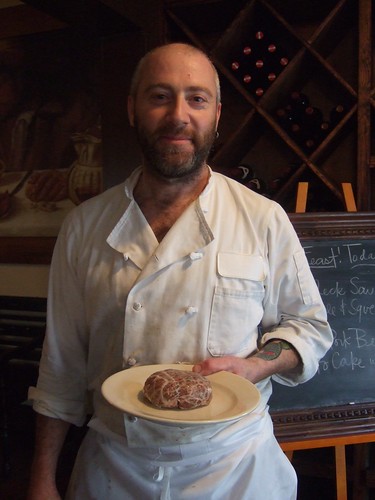
Chef Richard Knight of Feast Restaurant
The ceremonial "entrance of the haggis" is a big part of a Burns supper, with a large haggis carried in as bagpipes play. Address to a Haggis is read, a toast is made with whisky, and the haggis is divvied up among the guests. During the recent Burns celebrations this past January, Houston's Feast Restaurant was asked to prepare haggis for several suppers here.
Feast is known for serving English cuisine, so I asked co-owner, chef and Englishman Richard Knight about Scottish haggis. "You don't see it a lot in England, but with the recent popularity of nose-to-tail cooking, you'll occasionally see haggis on menus in London." According to Knight, his English business partner and chef James Silk spent time cooking in Edinburgh (Scotland), and that's the basis for their recipe.
In addition to making haggis for Burns suppers, Feast put the dish on its regular menu over a weekend in January. It's rarely on the menu at Feast, and I've never seen it on any other restaurant menu in Houston. I'd never tasted haggis so I made a reservation for dinner, bringing along my friend Peggy, an American who had lived in Scotland and eaten the haggis there. Referring to the Feast version, she commented, "It's meatier than the haggis I remember. I recall a lot more filler in Scotland, a lot more oats." That said, we both agreed that the haggis at Feast was delicious.
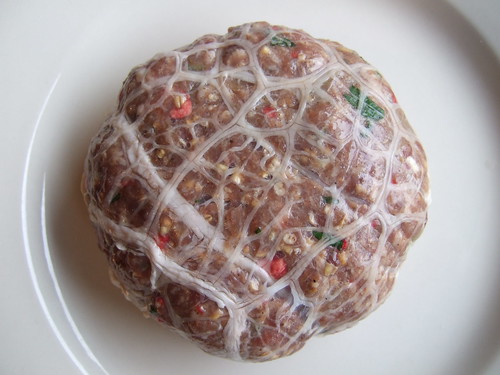
Uncooked haggis at Feast
The comment regarding "filler" in haggis is pertinent. Like a lot of infamous or exotic dishes, the recipe for haggis is historically made up of stuff left over after the "good stuff" is finished. So after the exquisite lamb chops and rack of lamb and other conventional cuts of the lamb were used (usually eaten by the wealthy), what was left over - the organs, etc. - were chopped up, mixed with "filler" (like oats) to make it more substantial and sometimes nutritious, and then served (usually to poor people) as a dish like haggis.
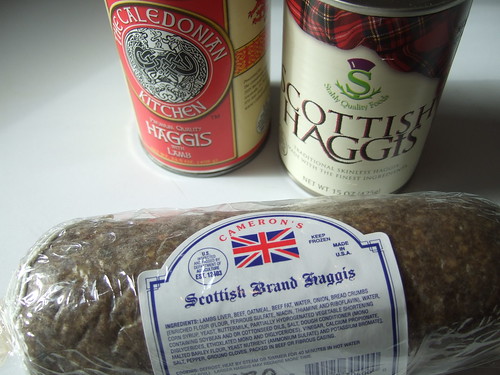
Canned and frozen haggis
Today, haggis isn't just a poor man's dish, and it's not just served in restaurants and at Burns suppers. Haggis is available in a can. And frozen. And it's shipped to haggis lovers (read: Scottish expatriates) all over the world. Except in the United States. In 1971, for health reasons, the U.S. prohibited the import of food containing sheep lung. Then in 1989, the U.S. banned the import of all beef and lamb from the United Kingdom due to the "mad cow disease" crisis. So what's a haggis-loving Scottish expatriate in the U.S. to do?
I called Debbie Tosh, buyer and general manager (and expat Scot) at British Isles, a store in Houston that specializes in products and food from the U.K. "We have canned haggis. It's made from Scottish recipes, but manufactured in the U.S." I asked the obvious question, how much of it does she actually sell? "We sell a lot. There's a big community of Scottish expatriates in Houston, mostly associated with the oil industry. We sell by the case for Burns suppers. And we do sell some as gag gifts."
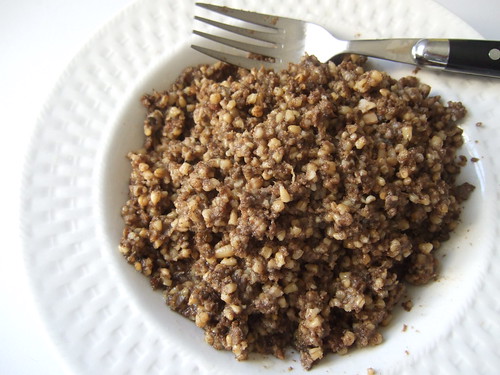
Canned haggis ready to eat
I bought a couple of different kinds of canned haggis at British Isles to try them out. One of them is made by Caledonian Kitchen which, ironically, is manufactured in Ohio by a company headquartered near Dallas by owners who have no connection to Scotland other than their distant ancestry. In 1992, on a pilgrimage to Scotland to trace his ancestry, owner Jim Walters got hooked on haggis. Back in the U.S. he realized there was no haggis to be found, so he made his own based on Scottish recipes. He started serving it at Scottish festivals in the U.S. and eventually started canning it and selling it.
In 2003, a Scottish magazine invited Walters to submit his haggis to a tasting competition in Scotland. Canned haggis from nine manufacturers in Scotland plus Walter's Texas haggis were entered. The Texas haggis came in an impressive 5th place. I asked Walters if he was there to accept either bouquets or brickbats from the Scots for his impressive placing. "No, they wouldn't let me attend. I think they thought I'd show up in a kilt and cowboy boots!"
So what does canned haggis taste like? First, it's more pungent than the Feast restaurant version. The earthy, meaty, somewhat metallic flavor of the offal (organs) is more pronounced, though not necessarily distasteful for most people. If you've ever eaten beef or chicken livers, the overall flavor of haggis is somewhat similar. The pungent flavor is cut by the nutty oats, which are more prominent in the canned version. The oats also offer a nice crunchy texture. The spices are also noticeable, and add an extra dimension of flavor.
My conclusion? Haggis is perhaps an acquired taste, but it's certainly nothing to be afraid of.
This blog entry was originally posted 15 February 2011 on the www.29-95.com website.
Monday, February 21, 2011
CFS Challenge: Black-eyed Pea vs. Saltgrass Steak House
We continue our search for the best chicken fried steak in Houston by visiting two chain restaurants known for tasty CFS.
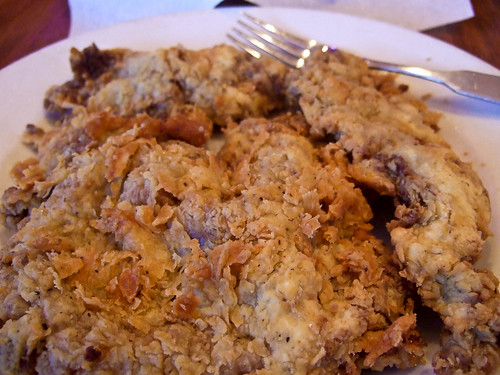
Chicken fried steak at Black-eyed Pea
The Black-eyed Pea restaurant chain has been around for decades, and in its earlier incarnation as a series of Texas-based, privately owned restaurants, earned a reputation for one of the best chicken fries steaks in the state. I hadn't visited a Black-eyed Pea restaurant in years, and hadn't had a CFS there in more than a decade. Did it still make a great CFS?
Similarly, Saltgrass Steak House started as a private restaurant chain in Houston and was eventually acquired by the Landry's Restaurant group in 2002. The CFS here is not often mentioned in Houstonians' or Texans' lists of great CFS, but it does seem popular with out-of-towners. I'd never eaten at a Saltgrass Steak House and it seemed like a worthy local competitor to the long-storied reputation of the Black-eyed Pea CFS.
Read More...Black-eyed Pea
On a recent weekday lunch the dining room at the only remaining Black-eyed Pea inside the loop (4211 Bellaire Blvd.) was full. The clientele was older. This isn't surprising, since the restaurant chain has been around for almost thirty years and the menu features the same "home-style" American comfort foods it has always served. Roast turkey breast, made-from-scratch meat loaf, pot roast, and of course chicken fried steak keep the regulars coming back year after year.
This is a table service restaurant. The dining room is comfortable and well-lit, if a bit the worse for wear, and my servers on this day were friendly and attentive. I noted that the market segment served by the Black-eyed Pea is quite successful — a step up from comfort food cafeterias like Luby's, but not as fancy or expensive as a slightly more upscale chain like Saltgrass. This is comfort food in a comfortable atmosphere at a comfortable price.
The CFS here comes in two sizes: the regular chicken fried steak ($8.99) and the "Texas sized" chicken fried steak ($10.99). Two vegetables, rolls and cornbread are included. I ordered the Texas size, with side orders of mashed potatoes and steamed broccoli, and the requisite ginormous glass of unsweetened iced tea.
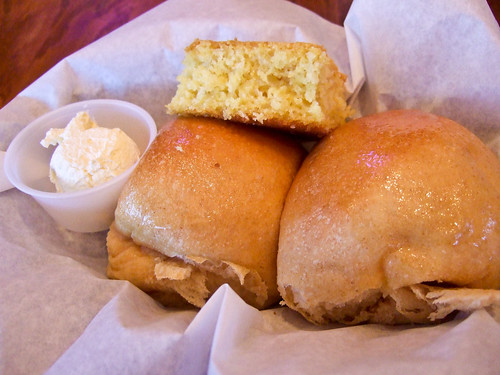
Rolls and cornbread at Black-eyed Pea
The breakdown
Meat: The Texas sized version filled a whole plate, with the meat aggressively tenderized -- in some places almost falling apart -- with a good thickness and properly seasoned. It was fork tender and contained only a couple of gristly pieces.
Crust: Fried golden brown, with areas that were thinner/thicker and lighter/darker with spots of the underlying meat occasionally peeking through. Nicely seasoned and flavorful. The crust adhered to the meat perfectly.
Gravy: It was average. Thickness and texture were good, with a respectable richness of flavor. Seasoning was light and meant to be inoffensive, I'm sure. Adding a bit of salt and a lot of pepper would greatly improve this gravy.
Value: Very good. For $10.99, the CFS was huge and well-executed and the sides were respectable. The bottomless basket of rolls and cornbread is a nice (and filling) tradition.
Extras: Excellent. The rolls and cornbread may not be like your momma made them, but they are addicting. The rolls are unusually, but not unpleasantly, sweet with a gooey, doughy texture. They come out steaming hot and drenched in butter. The cornbread is similarly sweet and addictive — certainly a crowd-pleaser but probably unacceptable to the purists who believe cornbread should feature a more bitter flavor.
Overall grade: B+ The Pea still makes a mean chicken fried steak. This will come as a relief to those of us who grew up on the CFS here, but don't get back often.
Saltgrass Steak House
Salt Grass Steak Houses dot the suburban landscape of Houston. I can never remember exactly where one is, other than it's usually somewhere along a major highway like I-10 or I-45. The closest one to my house is on I-10 near Shepherd, and that's where I visited on a recent weekday lunch. This location has a small dining room with clubby, comfortable booths lining the walls. The crowd consisted mainly of urban professionals and office workers.
For lunch, you've got two choices for the CFS: the "lunch cut" ($9.99) and the full dinner size ($13.99). The dinner portion includes a soup or salad, beer bread, and one side dish. I went with the full dinner portion, a salad, and a side of macaroni and cheese.
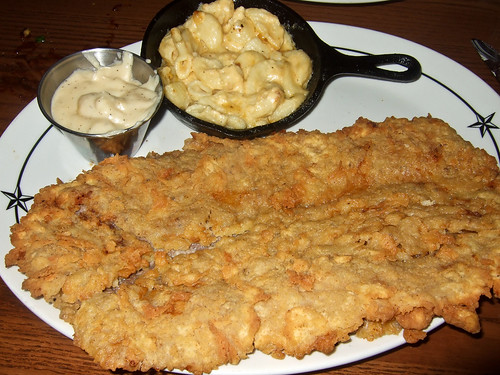
Chicken fried steak at Saltgrass Steak House
The breakdown
Meat: Nicely tenderized; perhaps too much, as the meat was a bit thin. Good flavor and freshness.
Crust: Flavorful, crispy and well-seasoned, but there was large amount of crust relative to the meat. There was virtually no adhesion of the crust to the meat, a deal-breaker for some.
Gravy: Outstanding, some of the best I've had in Houston. Wonderfully creamy texture, great depth and richness of flavor. Good seasoning. I'd even like a bit more pepper in there.
Value: Good. $13.99 for a large CFS, side and salad is very reasonable.
Extras: Poor. The "beer bread" that accompanied our lunch on this day was dry, crumbly and flavorless. The salad was a standard-issue iceberg lettuce concoction.
Overall grade: B. The CFS at Saltgrass is overall pretty good, but somewhat thin relative to other chicken fried steaks in Houston, and the lack of the traditional rolls and cornbread is a drawback in my opinion.
The Black-eyed Pea takes this round. The overall quality and value is excellent. But like any CFS comparison between two restaurants, wishful exchanges of different components is always in order. The Black-eyed Pea rolls and cornbread would greatly improve the experience at Saltgrass. The Saltgrass gravy would push the Black-eyed Pea experience into the A or A- category. Such is the creative thinking of the CFS connoisseur.
~ ~ ~ ~ ~
Previous CFS challenge:
CFS Challenge: Hickory Hollow vs. Ouisie's Table
This blog entry was originally posted 7 February 2011 on the www.29-95.com website.
Tuesday, February 8, 2011
Turkish Cuisine Delights
The staff at Istanbul Grill in Houston's Rice Village wear T-shirts emblazoned with a symbol of concentric blue and white circles. Round glass objects of the same design hang from the walls of the restaurant.

Nazar boncugu, or the Turkish evil eye stone
For anyone who has ever visited Turkey, you will recognize these objects as the same ones sold in stalls of Istanbul's Grand Bazaar, hung from the walls in commercial establishments, and dangled from the rear-view mirrors of taxicabs. This is the nazar boncugu, or the evil eye stone that's meant to ward off bad spirits. It's the first and most prominent sign that you are in one of Houston's relatively few Turkish restaurants.
Just looking at the menu here, you might not be so sure you're in a Turkish restaurant. Kebabs, hummus, tabouli and baklava are prominently featured — all dishes with a Mediterranean, Middle Eastern or South Asian association, at least to the eyes (and palate) of the Western diner. Undoubtedly, native Turks would vehemently disagree that the kebabs produced in Istanbul are even remotely similar to those made in Tehran, much less London or Berlin. If politics and religion are historically the major sources of international conflict, a nation's claim to its cuisine, dishes and ingredients can't be far behind.
Read More...In Houston, Turkish cuisine is less well-known than its culinary cousins from Greece, India, Pakistan or Lebanon. Three (out of maybe four or five) of Houston's Turkish restaurants are located a couple of miles from each other inside the loop — Istanbul Grill and Pasha in Rice Village, and Turquoise Grill just north on Kirby near the Southwest Freeway. Although menu items may seem similar, it's been my experience that Turkish cuisine in Houston has stayed closer to its roots than Greek or Indo/Pak cuisine, which over the years has ballooned in portion sizes and unsubtle uses of mass-produced ingredients and palate-destroying spices. Much of the Turkish cuisine you get in Houston is simple, fresh and flavorful, and accommodating to both meat lovers and vegetarians alike.
A meal will often begin with a glass of hot tea, or cay (pronounced chai). Drinking tea in Turkey is an important social tradition — outdoor cafes are filled with Turks drinking tea, smoking and socializing, all tended to by waiters darting between tables, carrying impossibly tall stacks of glasses in each hand. On the occasion I've stepped in to a Turkish restaurant in Houston for an order to-go, the owner will often bring out a glass of hot tea while I wait — a perfect example of the hospitality for which Turkish people are known.
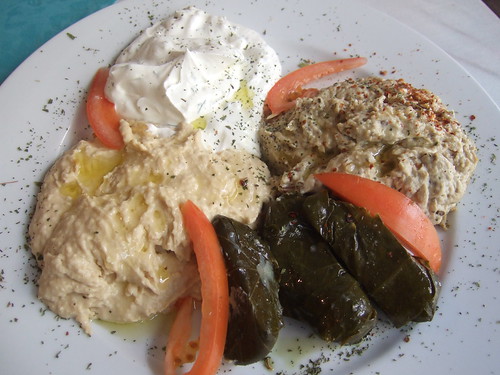
Meze tabagi, or mixed appetizer plate at Turquoise Grill
The appetizer course of a Turkish meal, the meze, is usually made up of soups, salads, dips and spreads, and small portions of meat or fish. Most Turkish restaurants offer a meze tabagi, or mixed appetizer plate, which allows you to choose 4-8 dishes to sample. It's a great way to try the many different options. On a recent visit to Turquoise Grill, we ordered a meze tabagi which included patlican salatasi (baba ghanoush, or cooked and mashed eggplant), hummus (chickpea dip), yaprak sarma (dolma, or stuffed grape leaves), and haydari (lebni, or strained yogurt). This course is served with pide bread, similar to the Greek pita bread, but thicker and fluffier, and often sprinkled with sesame seeds.
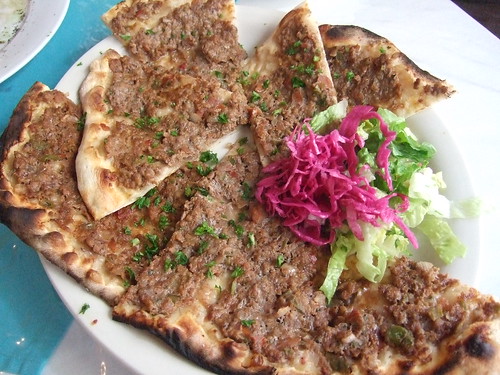
Lahmacun at Turquoise Grill
Main courses feature a wealth of fried and grilled meat and seafood dishes, as well as dishes featuring wonderfully grilled and seasoned vegetables that are a godsend for long-suffering vegetarians. The usual beef, chicken and lamb kebabs are here; for a distinctive Turkish version try the Iskender kebab, named after its Turkish inventor, Iskender Efendi. Long, thin slices of doner kebab (lamb) are layered over butter-soaked pieces of pide bread, then topped with a tomato sauce and served with a side of yogurt. Another unique Turkish dish is lahmacun (pronounced lah mah zhoon)— crispy, thin pide bread topped with a paste of minced lamb and beef, onion, tomato, garlic and parsley. A side salad of crispy, vinegary red cabbage and lettuce is spread on top, a squeeze of lemon is added, and the lahmacun is rolled or folded together and eaten by hand.
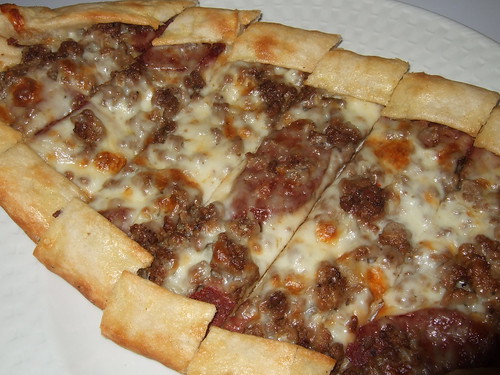
Meat pide (Turkish pizza) at Pasha
Another type of "Turkish pizza" is known as pide, named after the pide bread that forms the crust of the boat-shaped pizza. Thicker and more substantial than lahmacun, pideler features many types of toppings such as sausage, cheese, beef and lamb. A delicious vegetarian pide features onions, bell peppers, tomatoes, mushrooms and cheese. And in an endearingly diplomatic gesture, many Turkish restaurants will list a "calzone" on the menu, really just a folded-over pide, for timid eaters or kids looking for something familiar.
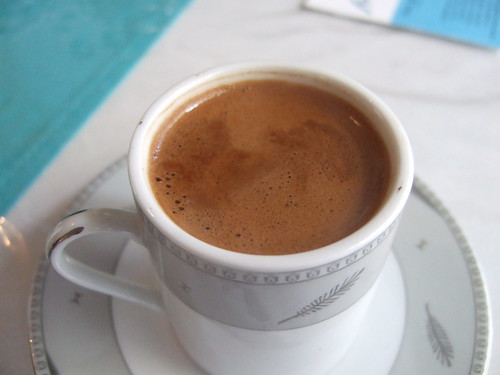
Turkish coffee at Turquoise Grill
There are the usual sweets for dessert — honey and pistachio-laced baklava, and a more subtle sutlac, or oven baked rice pudding. But the true culmination of any Turkish meal is coffee. Turkish coffee is not distinguished by the ingredients (though it is often infused with sugar or cardamom), but rather by the preparation method. Coffee beans are ground into the finest possible powder, then mixed with hot water until the flavors are extracted and the powder settles on the bottom of the cup. The result is visually murky, with a grainy-thick texture, and with an intensely focused flavor of coffee-caramel-earthiness.
Much like the diverse nation of Turkey, which sits at a geo-political crossroads between Europe and Asia, the cuisine of Turkey is a rich fusion of dishes and ingredients derived from neighboring regions, as well as dishes unique to the country itself. The Turkish restaurants of Houston offer an authentic snapshot of this world-class cuisine and culture that is a fresh, unique and reasonably priced alternative to the city's usual Mediterranean food offerings.
This blog entry was originally posted 24 January 2011 on the www.29-95.com website.
Friday, January 28, 2011
Spaghetti all'amatriciana: Layers of flavor and history
The Via Salaria — the Salt Road — was one of the earliest roads built by ancient Rome to lash together its far-flung empire.
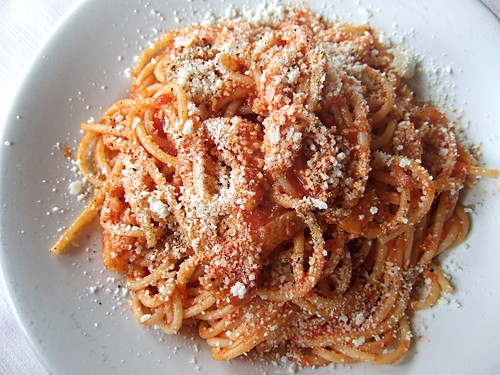
Traditional spaghetti all'amatriciana at La Conca in Amatrice, Italy
The actual path of the road predated the Romans — the Sabine people of central Italy would trek down from their mountain redoubts to the mouth of the Tiber river, where they would collect sea salt which at the time was a prized commodity. Today the Via Salaria is labeled the SS4, or Strada Statale 4 (State Highway 4). It's an otherwise mundane two-lane blacktop that overlays the track of the original Roman road, exceptional only in the path of history which it follows both literally and figuratively.
Read More...
The Via Salaria north of Rome, Italy
We were driving north on the SS4 from Rome to the small town of Amatrice. It's generally agreed that Amatrice is the birthplace of the classic pasta dish spaghetti all'amatriciana. I'd eaten amatriciana for years when visiting Rome, but like many dishes and cuisines in this part of Italy, the provenance, recipe and ingredients of amatriciana were all in dispute. I decided to visit the supposed birthplace of the dish and find out what an authentic version of amatriciana really tastes like.
First, a few notes about the many-layered history of the dish. The basis for the recipe begins in the 15th or 16th century when migrant shepherds living in a nearby town used readily available ingredients to make the classic dish pasta alla gricia. The ingredients were pecorino (a readily available sheep's milk cheese), guanciale (salt-cured pork cheek), black pepper and dried pasta (the final three ingredients being resistant to spoilage). Pasta alla gricia became known as amatriciana bianca or the "white amatriciana," referring to the color of the sauce made from the pecorino cheese.
Then, sometime in the 17th century, the tomato was introduced to Italy from the New World. It was only then that the Italian love affair with tomatoes began. Tomato sauces became a staple of Italian cooking, and eventually came to define Italian cuisine as it traveled with waves of Italian immigrants all over the world. The classic amatriciana bianca recipe was no match of this pomodoran invasion, and a generous portion of tomato sauce was layered on top of the original shepherd's concoction. Somewhere along the way, red pepper flakes were added to the recipe to give it some spicy heat. Amatriciana bianca had transformed into amatriciana rosso and a canonical recipe was established.
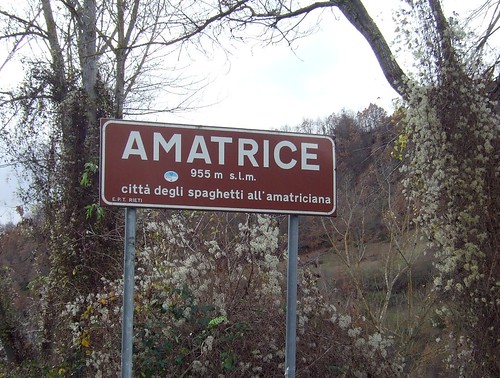
The road sign leading into Amatrice, Italy
As we drove into town, a sign announced our arrival into Amatrice. While signs in the U.S. may celebrate a city as home to the largest ball of twine or the local high school football team, city signs in Italy often denote the birthplace of an emperor, or perhaps more importantly, the birthplace of a dish like spaghetti all'amatriciana. Such was the case in Amatrice.
Our destination was Albergo-Ristorante La Conca, a source for traditional amatriciana mentioned in the book Italy for the Gourmet Traveler. The restaurant was empty for lunch on a bright day in November (off season for this area of Italy). But the staff was eager to take care of us; they knew exactly what we wanted when we walked in the door (did we have an American flag painted on our foreheads?). The spaghetti all'amatriciana here hewed to the traditional recipe: pecorino, guanciale, tomato sauce, black pepper, red pepper flakes and dried spaghetti pasta. It was the best I've ever had.
But the story doesn't end there. The amatriciana I ate in Amatrice only vaguely resembled the dish I'd eaten in Rome for so many years. What accounted for the discrepancy? The ancient Romans, of course, were known for assimilating the culture and traditions of its conquered peoples. Similarly, and perhaps even more controversially, contemporary Romans have assimilated amatriciana as a classic dish of cucina romana — the cuisine of Rome.
This next layer in the flavor and history of amatriciana originated when migrations from the countryside (Amatrice) to the city (Rome) brought an influx of regional cooking into the capital city. There, the dish got its own slightly different version of the name: pasta alla matriciana. Ingredients were added in various combinations: onions, garlic, white wine, basil, sage. The pasta is usually bucatini, a thicker, hollow version of spaghetti. Indeed the dish I'd been eating in Rome all those years was bucatini alla matriciana. A delicious dish no doubt, but lacking in the focused simplicity of the classic spaghetti all'amatriciana I sampled in Amatrice.
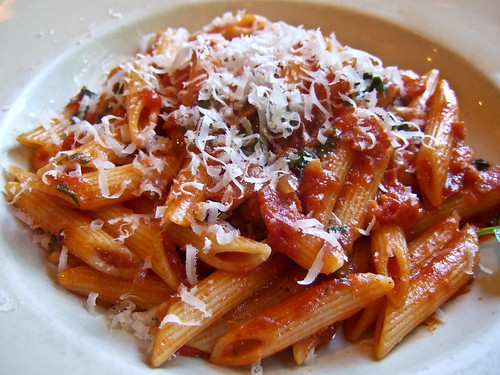
Penne amatriciana at Nino's in Houston
Back in Houston, I searched for a restaurant that serves amatriciana. Could I find a faithful representation of this dish in a city known for many middling Italian restaurants, and only a few good ones? Scouring restaurant website menus yielded one solid result: the "penne amatriciana" at Nino's on West Dallas. A weekday lunch visit revealed a generous portion of the dish that was both delicious and well-made, if not wholly faithful to the original recipe. The amatriciana at Nino's included onions, making it a closer relative of the Roman version. In a nod to the Americanization of the recipe, pancetta is substituted for guanciale (which can be hard to find in the U.S.), and Parmigiano-Reggiano cheese was offered instead of pecorino.
Still, even if a restaurant in Houston offered a faithful recipe of the dish, it would be difficult to exactly reproduce the version from Amatrice due to the obvious lack of access to the local Italian ingredients: the velvety richness of the rendered guanciale, the salty sharpness of the local pecorino cheese, the tangy sweetness of the Casalino tomatoes that are a hallmark ingredient of the dish in Italy. Certainly, using the original recipe and good quality ingredients, a delicious approximation of the dish is possible outside of Italy. But I've resigned myself to the fact that a taste of the real amatriciana is only attainable by a flight to Rome and a drive north on the Via Salaria to Amatrice — the "citta degli spaghetti all'amatriciana."
This blog entry was originally posted 12 January 2011 on the www.29-95.com website.
Monday, January 17, 2011
Restaurant rules to survive (and thrive) by
I recently wrote about etiquette tips that diners can use to make the restaurant dining experience more enjoyable. Similarly, there are rules that restaurants can follow to make the diner's experience more enjoyable and thus have the salutary effect of creating a successful and thriving restaurant.

The rules at Gilhooley's oyster bar are short and sweet.
These rules may seem obvious. But a sampling of several new restaurants opening in Houston reveals surprising oversights in even the most basic tenets of running a restaurant. Reasons are numerous and well-documented -- a wealthy owner with more money than experience; a celebrated chef striking out on his/her own who, when faced with the day-to-day business of running a restaurant, can't keep up in the kitchen.
All reasonable explanations for why a restaurant might be destined to fail. But by following just a few simple rules, a restaurant can survive the worst of times and thrive in the best of times. I've had the good fortune of working in a restaurant run by consummate professionals, and several of these rules were learned in that milieu. Others are more common sense, or learned from being a regular patron in many thriving and not-so-thriving establishments. I'd suggest that a restaurant could survive if it ignores a few of these rules, but I doubt one could thrive without following all of them.
Read More...1. Serve food people want to eat. To be successful in business, you have to supply a product that the market demands. But many new restaurants have a visionary or artistic concept/menu that is foreign to potential diners. Should a restaurant serve "avant-garde" food or "comfort" food? This is a point of some debate in the Houston food community. Many recently opened restaurants are serving comfort food -- fried chicken, burgers, pizza -- i.e. food with which people are familiar and comfortable. The knock on this trend is that the food choices in Houston are becoming homogeneous (the phrase you often here is that Houston as a whole "doesn't have an adventurous palate"). But many restaurateurs respond by saying, "We're not here to reinvent the wheel; we just want to serve good food and make a living at it." Fair enough. But for the ambitious chef, this may not be good enough. And it's obviously not good for those Houstonians who do enjoy trying new and different cuisines. So in the case of an ambitious chef, rule #2 may apply.
2. Give people what they want, then later you can give them what you want. In the classic food movie Big Night, scheming restaurateur Pascal, whose highly successful restaurant serves schlock Italian food, gives this advice to failing restaurateur Secondo, who insists on serving only the most uncompromisingly authentic Italian food: Give people what they want, then later you can give them what you want. Cynical advice from a not-very-sympathetic character to be sure, but the words ring true. An ambitious chef with a singular vision should, by all means, open a restaurant that does not compromise on its beliefs. But if a chef, perhaps relatively unknown, wants to realize a vision while hedging his chances of success, he can create a menu that includes conventional dishes as well as "haute cuisine". Then, as his clientele grows, he can expand his offerings of inventive and visionary dishes, thereby fulfilling his ambitions while at the same time expanding the palates of his diners.
3. Spend good money on a capable sous chef. Too many restaurants develop a reputation for inconsistency because on the days when the executive or "name" chef is off, the food is opined to be inferior. A capable second-in-command for the kitchen who can faithfully and consistently reproduce the quality of the restaurant's dishes is invaluable. Really, there's no better investment for a restaurateur than a loyal, capable and reliable sous chef.
4. Don't skimp of front-of-house talent. It's a common refrain from restaurateurs and chefs in Houston -- it's hard to find good help. And although there are some restaurants who can put together a professional FOH staff from top-to-bottom, most restaurants have to get by with a relatively inexperienced team of servers. And that's fine. In general, Houston diners out for a casual meal aren't going to demand formal service. Unfortunately, I've been in highly regarded restaurants where the service falls apart when the restaurant gets busy. At the very least, every restaurant should have a couple of FOH veterans who can act as floor managers and keep things running smoothly when the restaurant gets busy, and always with an eye for details, which brings us to rule #5.
5. Do sweat the small stuff. My first restaurant job was as a busboy in an upscale French restaurant. After setting a table, the owner would review your handiwork, and if the utensils were not placed at an exactly prescribed distance from the plate, you'd receive a firm-but-polite dressing-down before the other staff. Some staff interpreted this as the owner's Napoleon complex, but really he was just setting a standard. If the service personnel are conscientious about the small details of service, the overall experience of both the diners and staff will be improved. This attention to detail can be manifested in many ways that make the diner's experience more enjoyable, and therefore more memorable -- a sincere smile from a hostess as he greets you, a server re-folding the napkin of a guest who has excused herself from the table, a busboy in a fancy French restaurant anticipating the drop of a utensil to the floor, and sprinting to replace it, even before the guest has the chance to reach down half-ashamedly to pick it up.
This blog entry was originally posted 3 January 2011 on the www.29-95.com website.
Friday, January 7, 2011
Resolve to explore Houston food in the New Year
It’s time for New Year’s resolutions, and my suggestion to Houstonians for 2011 is to get out of your comfort zone when it comes to food.
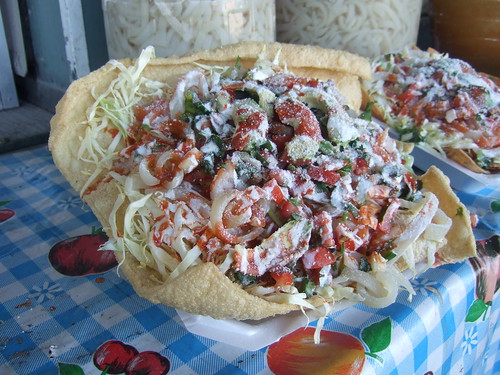
The mysterious chicharrón tostada
Food, of course, is all about comfort, and there’s nothing more frustrating than spending your hard-earned money on a dismal meal. For that reason, we tend to stick with our tried-and-true when it comes to dining out. That’s understandable.
On the other hand, Houston is blessed with one of the most diverse food scenes in the country, and eating at the same places every day is simply untenable for anyone who wants to enjoy and soak up everything that our great city has to offer. But it’s hard to find new, good places to eat.
With that in mind, I’ve put together a list of “food streets” in Houston that offer great opportunities for food exploring in 2011. The concentration of good eats on these streets should provide a higher likelihood of finding new and interesting food.
Read More...As with any new and different experience, exploring good food and restaurants requires patience, common sense and an open mind. You may find some places where no one speaks English and the menu is written entirely in a foreign language. In this case, you can just look around at other tables and point to dishes you find interesting. In most cases, the staff and fellow diners are friendly and accommodating — sometimes you’ll even find another diner willing to translate.
Similarly, you may walk into a restaurant that seems unsanitary or just “off.” In that case, I ask for a to-go menu and vow to come back later, if warranted. You can always check the Houston Health Department’s website, houston.tx.gegov.com, for a restaurant’s inspection record.
With those brief tips in mind, here are few food streets that you should resolve to explore in 2011. Felice anno nuovo e buon appetito, feliz año nuevo y buen apetito, bonne année et bon appétit, happy new year and good eating in 2011.
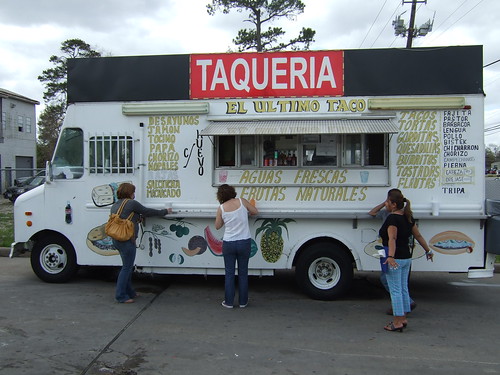
El Ultimo taco truck
LONG POINT ROAD between Gessner and Hempstead I call this the “granddaddy” of Houston’s ethnic food streets, as it has been a destination for Houston food explorers for decades. Anchored to the west by some of the city’s best Korean restaurants and to the east by Vieng Thai, arguably Houston’s best Thai restaurant, this street includes a huge variety of taco trucks, carnecerias, flea markets and specialty food shops. The intersection at Blalock is particularly fertile: check out Korea Garden (fun grill-it-yourself joint) and the massive Super H-Mart, a Korean supermarket where the food court has some of the most authentic and tasty Korean food in the city. Antoine is the usual location of El Ultimo taco truck, known for great tripa and chicharrón tacos. Further east, in the same strip center as Vieng Thai, is El Hidalguense, known for its open pit grill used to cook tasty cabrito (goat).
AIRLINE DRIVE between the North Freeway and West Gulf Bank. If there is a wild west of Houston ethnic food, it’s this stretch of Airline north of the North Freeway. Starting in the north, the giant Sunny Flea Market harbors innumerable stalls for tacos, elotes, and the mysterious chicharrón tostada. This tostada features shredded cabbage, pickled pork rinds, tomatoes, avocados and a red sauce all cradled in a large (and edible) slab of fried pork skin. Even friends that are eminently knowledgeable about Mexican food debate the origins (and official name) of this dish, and the taste is unique to say the least. Across the street, Buey y Vaca is a Houston institution and raucous shrine to Mexico-style tacos. Further south, past untold numbers of taco trucks and food stands is Tostada Regia, a family-friendly joint featuring more traditional tostadas (crispy corn tortillas and toppings) from northern Mexico.
HILLCROFT AVENUE between the Southwest Freeway and Westpark Tollway. This short length of Hillcroft (it can be walked) is jam-packed with the city’s best South Asian and Middle Eastern restaurants and shops. The shopping center at the Southwest Freeway intersection features two of Houston’s best Indian restaurants: Himalaya (Indian-Pakistani cuisine) and London Sizzler (British-style Indian cuisine). Further north, Bijan Persian Grill offers a more upscale taste of Persian (Iranian) cuisine, while Darband Shish Kabob has been serving inexpensive, delicious Persian food in a spartan yet lively dining room for many years. Across the street is Shri Balaji Bhavan, arguably Houston’s best south Indian (vegetarian) cuisine.
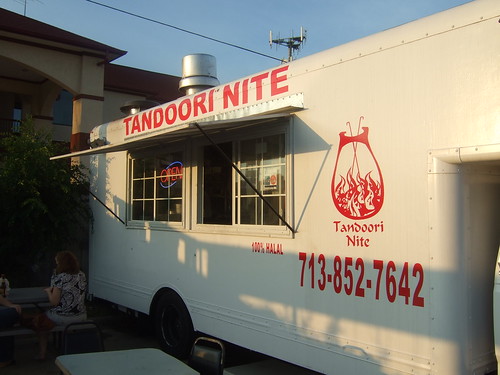
Tandoori Nite food truck
TEXAS 6 between the Katy and Southwest freeways. A relative newcomer to the local food scene, this wide stretch of highway in far west Houston is the main artery for a surprisingly diverse suburban neighborhood. Toward the north, funky bars like Paul's Boat and The Dam Ice House serve up lots of cold beer and local flavor. Further south, Tortas Las Llardas offers a large menu of tortas, or Mexico-style sandwiches. Mr. Trompo serves Monterrey (Mexico) style cuisine, specifically tacos made from meat grilled on a trompo (a rotating, upright roaster). The Tandoori Nite food truck sits in a gas station parking lot near the intersection at Beechnut and serves up some of the best Indian-Pakistani street food in Houston.
BELLAIRE BOULEVARD between South Gessner and South Kirkwood. Known as Houston’s “New Chinatown,” this street is anchored by the dazzling Hong Kong City Mall to the west, and numerous small restaurants and shops to the east: Fu Fu Cafe for exquisite soup dumplings, Sinh Sinh and Jasmine restaurants for great Asian/Vietnamese/Chinese, and Umai for some of Houston’s best non-sushi Japanese food. For a truly different dessert experience, head over to Juice Box or Star Snow Ice for traditional Chinese/Taiwanese concoctions featuring a fluffy pile of shaved ice drenched and topped with ingredients such as tapioca, coconut milk, grass jelly and fruits.
This blog entry was originally posted 23 December 2010 on the www.29-95.com website.
Monday, January 3, 2011
Courtbouillon: A Cajun Classic
The French culinary term “court bouillon” (or court-bouillon) conjures images of royalty and kings (court) as well as wealth and gold (bouillon). In reality, of course, it is something far more mundane, loosely translating to “quick broth.”
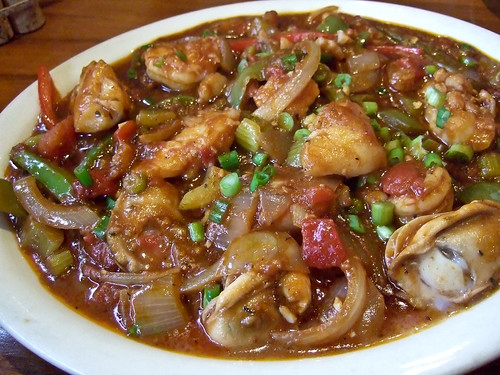
Courtbouillon at Danton's
In practice, court bouillon is usually just boiling water that’s been seasoned and infused with aromatics and then used to poach fish. In the grand encyclopedia of French cuisine, court bouillon is really rather simple and boring.
Now consider the term courtbouillon (one word), a Cajun dish. Pronounced koo-bee-yahn, it’s a fish or seafood stew that’s a tomato-based cousin of gumbo and etouffee. And unlike the weak sauce of it’s French ancestor, courtbouillon is a rollicking, rich and flavorful dish worthy of its Cajun provenance. In musical terms, court-bouillon is a delicate French minuet while a Cajun courtbouillon is a full-on fais do-do, fiddles and accordions blazing.
Read More...You start with a roux. Then add the Cajun trinity: bell pepper, onion and celery. Fresh, diced tomatoes are next, followed by seafood stock and then any number of additional spices and herbs: thyme, garlic, marjoram, basil. Bring to a boil and then simmer, allowing the mixture to reduce and thicken, stirring occasionally. Then add thick chunks of fish and allow them to cook in the stew. Once cooked, ladle the fish and stew into a bowl over steamed white rice. In general, the recipe can be lengthy and involved. (A Google search will turn up many versions for the ambitious home cook.)
I asked Jim Gossen, a native of Lafayette and owner of Houston’s Louisiana Foods seafood distributorship, about the recipe for courtbouillon. “It’s traditionally a dish made at home, using family recipes. After I make the stew, I layer in thick pieces of redfish, then top it with thin slices of lemon. After you add the fish, you can’t stir it anymore, otherwise the fish breaks into pieces. So as it simmers, you grab the handles of the pot and twist it back and forth to make sure everything cooks evenly,” Gossen said.
Like most dishes that are handed down through traditional family recipes, courtbouillon has many variations. There always is a roux, but whether it is light or dark is up to the cook (tradition says dark). The Cajun trinity is a must, but some recipes call for garlic at this step. Once the stew ingredients have been added and are ready for simmering, a whole fish head sometimes is thrown in for extra flavor (don’t forget to fish it out before serving!). The fish used is another subject of debate: redfish is the traditional choice, but catfish often is used and red snapper is not unusual. And why stop at fish? Many recipes call for a “seafood courtbouillon,” which includes shrimp, oysters or crawfish.
So what do you do if you want to try out this Cajun classic in Houston and you don’t have access to a friend-of-the-family Cajun cook or don’t want to make it yourself? While not as prevalent on restaurant menus as gumbo and etouffee, some of Houston’s best Cajun and Creole restaurants include courtbouillon on the menu, including Danton’s Gulf Coast Seafood Kitchen and Mardi Gras Grill, both of which serve a mixed seafood version. Brennan’s, traditionally known for New Orleans Creole-style cooking, includes a redfish and shrimp courtbouillon as part of its “Brennan’s Classics” menu, and properly describes it as “Acadian style.”
Danton's Gulf Coast Kitchen
During a recent weekday lunch, I sampled the seafood courtbouillon at Danton’s on Montrose near the Museum District. It’s a throwback seafood joint offering classic Gulf Coast dishes using traditional recipes, as well as signature dishes (“Crab Danton”) created by chef and co-owner, Danton Nix. Danton’s makes my favorite gumbo in Houston — extra rich, dark and smoky — so I had high hopes for the courtbouillon.
The courtbouillon at Danton’s is excellent. A huge portion served on a big oval plate, the stew has a perfect consistency and reddish-brown color. It came out steaming and so hot I had to wait, torturously, to take a bite. The Cajun trinity is prominent — big, tender chunks of onion, bell pepper and celery are splashed throughout. The flavor of the stew is the perfect combination of smoky richness from the roux and tangy sweetness from the tomatoes. Big, intact chunks of fish (no stirring!) are generously spread throughout. My server identified the fish as red snapper, though it easily could have been redfish. Perfectly cooked shrimp and fresh oysters round out the dish. For sides, I always get steamed white rice and garlic bread for sopping up what’s left of the stew.
I can’t wait to find and taste more versions of courtbouillon on Houston restaurant menus. And if I get ambitious, I may have to try making my own, hopefully with a little help from some of my Cajun friends.
This blog entry was originally posted 20 December 2010 on the www.29-95.com website.
Wednesday, December 15, 2010
CFS Challenge: Hickory Hollow vs. Ouisie's Table
This chicken-fried steak (CFS) challenge features two of Houston's traditional CFS heavyweights: Ouisie's Table and Hickory Hollow. Although the chicken-fried steaks at these two restaurants are consistently rated as the best in Houston, both the restaurants as well as their corresponding steaks are worlds apart.
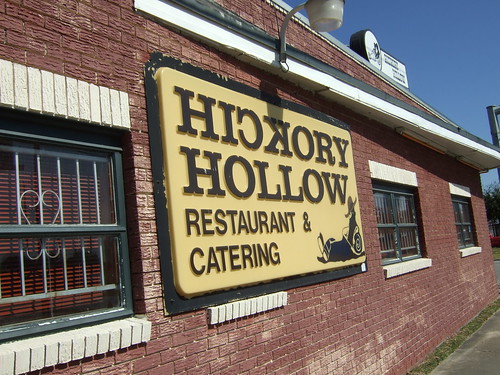
Hickory Hollow
Hickory Hollow
Hickory Hollow has been serving CFS and other comfort foods in gigantic portions at reasonable prices since 1977. Located in a time-worn brick-sheathed building on Heights Boulevard (there are two other locations) just north of a rapidly gentrifying stretch of Washington Avenue, it caters primarily to a mixed blue-and-white collar crowd. On a recent weekday lunch, the restaurant was packed with a mix of downtown office workers, hipsters from the adjacent Washington corridor, elderly patrons who appeared to be longtime regulars (judging from the banter at the counter), and a table full of police officers.
Read More...This is a counter-service restaurant: get in line and peruse the wall-mounted menu. Step-up to the counter, place your oder, pay, and then you get one of those buzzer things to take with you to your table. You are provided with a tray, and you pass through a salad bar and self-serve drink area. It's a great communal atmosphere, with small four and two-top table intermixed with communal and picnic tables. When the buzzer goes off, you trek back to the counter to pick up the order yourself.
The CFS comes in a whopping four sizes: from the "Small Cowgirl" (billed as "perfect for the ladies"), the "Small Plowman" ("perfect for lunch"), the "Medium Hired Hand" ("Texas size"), and the "Large Rancher" ("the Saddle Blanket"). Prices are very reasonable, ranging from about eight dollars to thirteen dollars. A salad is included, and a choice of fries or a baked potato. I ordered the Large Rancher with fries ($11.49).
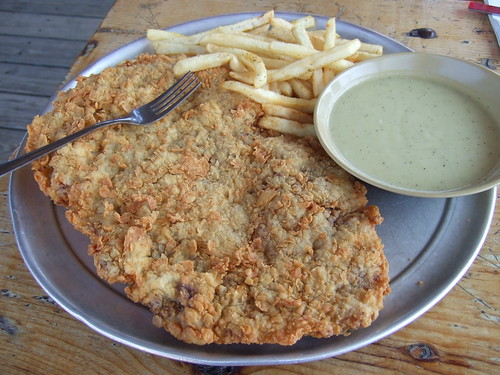
Hickory Hollow CFS
The breakdown:
Meat. The steak itself was fresh, nicely tenderized (fork tender), with a good thickness and perfectly cooked. Regrettably, the meat itself was completely devoid of seasoning.
Crust. The crust was fried to a gorgeous golden-brown color - this is what a CFS is supposed to look like. The crust was wonderfully crispy and although it pulled apart from the meat, the overall technical execution of the steak was excellent. Unfortunately I found the crust, like the meat, to be devoid of any flavor or seasoning.
Gravy. It's possible for a bland CFS can be rescued by an otherworldly gravy, but that wasn't the case here. Supposedly a cream gravy, this gravy had an unusual yellowish tint and a gummy texture. It reminded me of the turkey gravy you get at Thanksgiving. Strangely, it is identified on the menu as "Texas River Bottom Gravy."
Value. Excellent. The mammoth "Large Rancher" CFS is a steal at $11.49 (with fries) or $13.49 (with baked potato).
Extras. I did not notice (and was not offered) any standard CFS extras like rolls or cornbread.
Overall grade: B- . That such a beautiful looking CFS could taste so bland is depressing. But if you can spice it up yourself with some salt and pepper, ketchup and tabasco, this huge portion at the right price is worth the trip.
Ouisie's Table
Ouisie's Table is a meandering maze of a restaurant off San Felipe in the decidedly upscale Afton Oaks/River Oaks neighborhood. The crowd is upscale too, as is the menu - billed as upscale southern food with eclectic tendencies. Still, sitting in the main dining area with other diners who, on another night, might be at Tony's or Del Frisco's, you can't help but feel at home. An army of servers and staff flitter about the room, graciously taking orders and fussing over the clientele.
The chicken-fried steak here is a centerpiece of a large menu of kicked-up southern comfort dishes like shrimp and grits and fried oysters. Ouisie's serves food that people like to eat - a restaurant strategy that isn't as obvious as you might think. And customers reward owner Elouise Adams Jones with an often full dining room.
Not unexpectedly, wine is big here. When we sat down, the waiter rattled off any number of expensive bottles and wines by-the-glass. I can't bring myself to drink wine with CFS, so I opted for a good ol' Shiner Bock (which turned out to be a great pairing). The CFS is billed as "The Ouisie’s Original Chicken Fried Steak with The Works" at a relatively eye-popping $23 for dinner ($17 for lunch). The "works" being mashed potatoes, gravy, black eyed peas, mustard greens, and corn pudding.
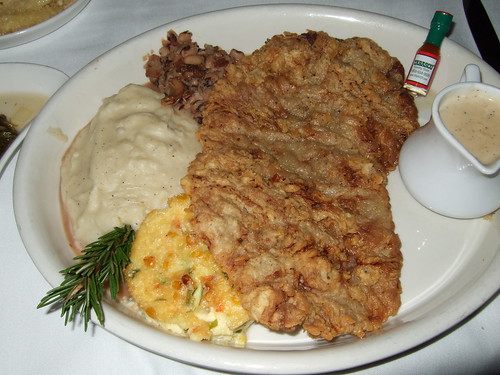
Ouisie's Table CFS
The breakdown:
Meat. The steak itself was pounded thin, very tender, with excellent moisture and good flavor. This is a high quality piece of meat.
Crust. Extremely crisp and crunchy, with an undulating golden-brown color, the steak appeared to be pan-fried (that may explain why the steak was slightly greasy). There was minor separation of crust and meat. Excellent flavor and seasoning.
Gravy. This is a peppery cream gravy in the classic Southern tradition. The flavor was outstanding, but the consistency was somewhat watery - I prefer my gravy a little thicker.
Value. Average. The large CFS and plentiful sides certainly justify the $23 price tag, but it's still a bit steep for a traditionally blue-collar dish.
Extras. Before the CFS came out, a plate of tiny biscuits and cornbread was provided for noshing. Tasty but not really impactful on the CFS experience. I single-serving bottle of Tabasco sauce was provided with the CFS - a nice touch. The mashed potatoes that came with the CFS were some of the best I've had in Houston.
Overall grade: B+. Great flavor and execution, along with some delicious sides, make up for the hefty price tag.
All things considered, Ouisie's Table wins the matchup with Hickory Hollow. Great flavor and abundant sides win out over the huge portions and reasonable prices.
This blog entry was originally posted 1 December 2010 on the www.29-95.com website.
Tuesday, December 7, 2010
Dining Tips to Live By
The observance of table manners is a tricky thing. I am by no means a stickler for table manners - I often catch myself with elbows on the table or talking with my mouth full.

Finger Lick'n Approved
I've had the occasion to learn some of the finer points of dining etiquette, which makes for some interesting people-watching. As a guest at one of Houston's most august country clubs, I've watched a Fortune 500 CEO push peas on to his fork with his fingers. As a volunteer at a soup kitchen, I've watched elderly patrons sip (never slurp) soup from a spoon with a technique worthy of the Queen of England.
So after decades of eating in restaurants, and especially the last few years eating in a lot of restaurants, I often get asked about how to deal with certain dining situations. Here are a few tips I've collected over the years, and that I find myself using on a regular basis.
Read More...1. Don't sniff the cork.
When evaluating a bottle of wine in a nice restaurant, never pick up the cork and smell it. I can tell you now what it smells like: cork. You can squeeze the cork and look at it to make sure it's in good shape. Then smell and taste the wine. For ladies on a date with Mr. Smooth Operator, if he picks up the cork and smells it, you know he's just winging it.
2. Never offer to do the math on a group check.
If you are in a big group and you can't split the check, somebody's going to have to figure what everyone owes and collect it. This is a good time to go to the bathroom. If you get stuck doing it, no one will believe they owe what you tell them they owe. "How much? But I only had one glass of wine!" You will be despised as you take their money, and in the end you will probably end up paying any shortfall yourself just to get it over with. If I'm with a group of friends and I've organized the event, I will occasionally just hand a credit card to the server and pay for it myself, then collect later.
3. If you have a reservation at a restaurant, don't get upset if your table isn't ready when you arrive on time.
It happens. Just sidle up to the bar and have a drink while you wait. If the wait is 30+ minutes after your reservation time, let the host know. If the restaurant is on the ball, they should offer to comp your drinks. On the other hand, if you are seated immediately and the host tells you that you have to be finished by a certain time so the table can be turned, you should say "No, thanks" and get up and leave. There are better ways for a restaurant to handle this. For instance, if a table is lingering (unreasonably) in a busy restaurant, the host should politely explain that other guests are waiting for tables and suggest that you adjourn to the bar with their coffee/wine/digestif.
4. Don't drink your dining companion's water.
Even after decades of eating in nice restaurants, occasionally I'll forget how the place setting works, especially on large 10- or 12-person tables where you're sitting all squashed together and the table is a sea of glasses and utensils. The trick to remembering is the 4 and 5 letter word rule. Fork and dish (4 letters) on the left (4 letters), knife and glass (5 letters) on the right (5 letters).
5. Food goes out on the same utensil it went in on.
It's always a conundrum: you've bit off a piece of steak that's too gristly to chew, or you've got a bad mussel. What to do with it? If you're in a casual atmosphere, no problem: just grab a paper napkin, raise it to your mouth and spit out the offending material. In formal restaurants, it's a bit more complicated. Etiquette suggests that you cup one hand over your mouth, raise your fork and spit the food out on to it, then discreetly lower the masticated food to the side of your plate. I've got about a 50 percent success rate with this one. Half the time the food rolls off the fork and plops into the middle of my dish. If a society-type lady is at the table and gives me a funny look, I just respond with a saucy wink.
6. In a restaurant, say "Please" and "Thank you" to your servers.
Waiters have endless stories about obnoxious guests, so we as diners can balance that out one thank-you at a time. I always say thank you to the server when they bring or remove my plate. Busboys in particular seem absolutely shocked and appreciative when you thank them for refilling a water glass. Of course, at those restaurants where they seem to refill your glass after every sip, you may want to pace yourself.
This blog entry was originally posted 24 November 2010 on the www.29-95.com website.
Tuesday, November 30, 2010
Almost Famous
There's been a lot of hand-wringing lately about the lack of national recognition for Houston's thriving food scene.

Pupuseria Emanuel
But God forbid, the day comes when selling yourself is as important as the music you make. - Russell Hammond
It's a legitimate argument - Houston and Houston's restaurants are mostly overlooked in the ubiquitous Top Ten Restaurant/Chef/City Lists that are like content crack for editors of national food websites and blogs.
The current skirmish springs from Houston Chef Bryan Caswell's appearance on the Food Network's high-profile cooking competition: The Next Iron Chef. Unlike a lot of reality cooking competitions that feature heavily tattooed and chain-smoking contestants who spend half the show sitting around an impossibly luxurious villa complaining about each other's fashion styles and grooming habits, The Next Iron Chef is actually known for testing the contestant's cooking chops.
Read More...Caswell was a perfect fit for the show, and for representing "H-Town." There are few chefs who are as hard working, classically trained, and firmly rooted as a native Texan. And if anyone can spread the gospel of Texas/Houston/Gulf Coast, it's the media-savvy Caswell. After a strong run though the show in which he gained accolades from the judges and grudging respect from his (mostly East Coast) competitors, it was a buffet of Gulf Coast cuisine that eventually did him in.
It was a "damned if you do, damned if you don't" moment - Caswell had to cook his native Gulf Coast cuisine (the theme of the challenge was "inspiration"), but putting an uber-regional dish like barbecue crab in front of a British food blogger (one of the judges) will always be a tough sell. And indeed, despite what looked like great dishes, Caswell was voted off The Next Iron Chef island.
Several days before the elimination show aired, Caswell penned a passionate defense of the Houston food scene on CNN's Eatocracy blog. He again pointed out that the city is regularly overlooked by the national food media, as exemplified by the fact that Eater.com, the national network of food blogs, recently launched a blog in Austin rather than Houston.
He's right: the idea that the Austin food scene - as good as it is - deserves more coverage than Houston is preposterous. As someone who has spent a lot of time in both places, Austin simply doesn't have the breadth and depth of food offerings that Houston does. I agreed with Caswell's implication that Eater.com's decision was driven more by style than substance, as did the echo-chamber of Houston's food bloggers and Twitterati (for what that's worth).
Ultimately, though, I kept thinking to myself, "Who cares?" Yes, Houston's restaurateurs and chefs must consider professional reputations and economic factors that could benefit greatly from more national exposure. But would that be good for Houstonians and the Houston food scene? Would Houston's chefs be better off showboating for a national audience like so many other regional chefs have done? As much as I'd like to see Houston chefs like Bryan Caswell, Monica Pope, or Chris Shepherd get their own TV shows, I'd much prefer them in their own kitchens cooking for fellow Houstonians. And somehow, I get the feeling, that's what they'd prefer to do too.
And even if there was a concerted effort to raise the national profile of the Houston food scene, how could you "brand" the bubbling cauldron of cuisines, dishes and ethnicities that make up the culinary landscape of Houston? ("Creole" and "New Creole" are terms that are sometimes used). The sheer size and diversity of Houston food scene is overwhelming even for those of us who spend a great deal of time trying to make sense of it all. On a recent speaking gig in Houston, TV food personality Anthony Bourdain admitted to being "intimidated" by Houston.
Chalk it up to fear of the unknown, I guess. On a recent jaunt down Telephone Road in southeast Houston, amidst an endless parade of shady lounges ("best mixed drinks" "set-ups"), taco trucks and car parts stores, I notice a ramshackle former drive-thru burger joint that had been transformed into "Pupuseria Emanuel." I checked the usual websites for information: Yelp, B4-U-Eat, Google. Nothing. I observed for a while. A steady stream of take-out traffic. I decided to give it a try.
Peering through the takeout window, I watched as two (presumably Salvadoran) women hurried back and forth in the small kitchen, preparing what seemed to be an endless number of takeout orders. I scanned the menu - I'm not an expert in Salvadoran food - which listed several different kinds of pupusas - basically thick corn tortillas stuffed with various ingredients. I settled on pupusas de pipián, a pupusa stuffed with a sauce/mole made from the seeds of the calabaza (winter squash). After waiting for what seemed like an eternity as my pupusas were made to order, the result was one of the most delicious, seasonal and inexpensive dishes I've had in Houston.
I couldn't imagine there being a better pupusa anywhere this side of El Salvador - not in Austin, Los Angeles or New York. But then I thought, how in the world can the Greater Houston Convention and Visitors Bureau possibly market Pupuseria Emanuel? The food is unique and great, but the menu is impenetrable for most people and the location is one of the "least scenic" (to be charitable) parts of Houston. And even if they did, do we really want Guy Fieri tooling up and down Telephone Road in his cherry red convertible with a camera crew in tow?
Recently, I re-watched the classic coming-of-age movie Almost Famous. It's about an obscure yet talented rock band with its coterie of fans, writers, and groupies who travel around the country playing gigs for the love of the music. Then the national media start to take notice, and the inevitable existential crisis occurs: do they stay small and true to their roots, or do they in some way "sell out" for bigger national exposure? (watch the movie to find out what they decide). I thought there were some interesting parallels between the talented musicians and dedicated hangers-on of the movie, and the free-wheeling, "almost famous" buzz of the Houston food scene.
Houston, it's all happening.
This blog entry was originally posted 17 November 2010 on the www.29-95.com website.
Tuesday, November 23, 2010
The Return of Chicken Fried Steak
A funny thing happens when you Google "sysco chicken fried steak." You're directed to a page on the website of Sysco Corporation, the foodservice giant. It is a catalog entry for the "Country Fried Steaks" that Sysco sells to restaurants.
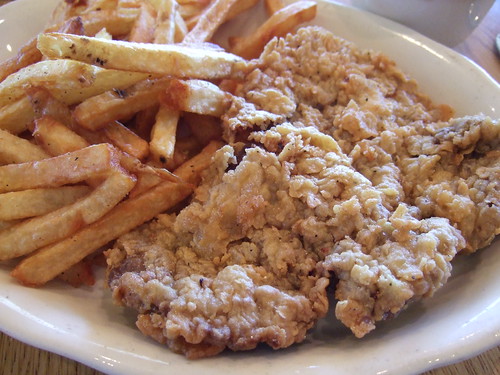
Chicken Fried Steak at Dot Coffee Shop
In the sugary promotional copy, these chicken fried steaks "have a natural shape" and a "made-from-scratch appeal." They're "individually quick-frozen" and "guaranteed to be preserved to perfection." It's enough to make any true Texan weep.
I'm not a Sysco hater. Some people profess to never set foot in a restaurant if they see a Sysco delivery truck outside. In reality, it's a rare restaurant that does not procure something from Sysco, even if it is just something non-food related like to-go boxes. Sysco provides a valuable service to restaurants in a professional manner. But the country fried steak thing bothered me.
Read More...I'd been tooling around Houston for a couple of weeks, checking out restaurants known for chicken fried steaks (CFS). Like everything else, some were good and some were bad. But on at least two occasions, I could have sworn I had eaten the exact same CFS at a different restaurant. That prompted my Googling. Sad to say, but at least one of these places - somewhat of a Houston institution - had been recommended for having great chicken fried steak (I can't get them to admit to using Sysco CFS, so they'll remain nameless for now). I came to realize that the quality of chicken fried steak in Houston just wasn't as good as it used to be.
I grew up in Beaumont, Texas. If you went to public school in Texas in the seventies and eighties like me, you probably remember looking forward to "chicken fried steak" day, or sometimes it was called "veal cutlet" day. These breaded steaks were certainly prefab, but they were unusually delicious, and the trick was to take one of the big fluffy rolls you got with lunch and make a CFS sandwich with them. Good eats.
Then in the early eighties, a restaurant called The Black Eyed Pea opened in an old house on Seventh Street in Beaumont. This is the same Black Eyed Pea chain that exists today, before it was corporatized, sold, bought, resold, bankrupted and its carcass picked clean by corporate raiders. Back then, the Black Eyed Pea made one helluva chicken fried steak (some claim it still does - it's on my to-do list). So big it covered the plate it was delivered on, it had a crispy, seasoned, golden-brown coating fused to a well-tenderized slab of top round steak. Peppery cream gravy on the side (always). Creamy mashed potatoes. Also, a basket of freshly-baked pull-apart rolls and sweet, crumbly cornbread. A ginormous glass of iced tea rounded out the experience.

Dot Coffee Shop
Can you still get a classic, made-from-scratch chicken fried steak in Houston? Yes, but it takes some research (tough job, but somebody's gotta do it). I'll spend the next few months traveling around greater Houston, and reporting on my findings. Surprisingly, a lot of the places people swear by for chicken fried steak aren't very good in my opinion. Some are just bad, some try to get fancy with presentation and ingredients, and some do indeed use the dreaded Sysco chicken fried steak.
I start by checking online menus of diners and comfort food restaurants in Houston. I stumbled across Dot Coffee Shop, a Houston institution, and a place I had never been. Diner food is hit-and-miss everywhere, but I had always heard good things about Dot. Dot is owned by the Pappas family of restaurants. In fact the Pappas family empire started with a Dot Coffee Shop downtown in 1967. The Dot on the Gulf Freeway is still going strong. On a recent Saturday morning, I waited about 20 minutes for a table.
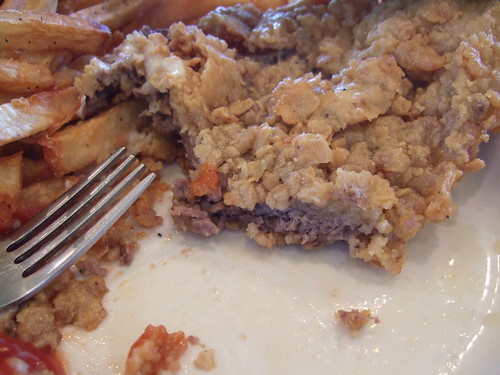
Chicken Fried Steak at Dot Coffee Shop
The CFS here is nicely sized, with a crisp, crunchy coating that adheres nicely to the well-tenderized steak. The coating is a golden brown, with light and dark patches (you don't want it too uniform), and a few splotches where the meat shows through the coating (again, the sign of a made-from-scratch CFS). Meat and coating are well-seasoned. It is fork-tender. In a slight deviation from protocol, the CFS is served with French fries instead of mashed potatoes, but that's fine by me.
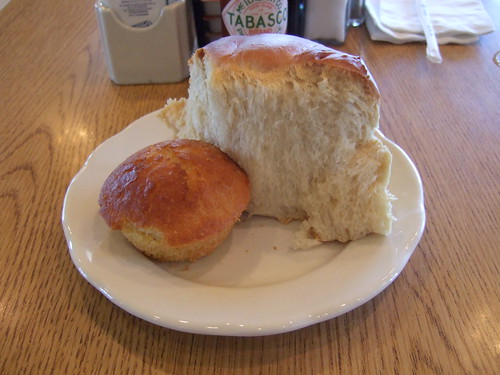
Rolls and Cornbread at Dot Coffee Shop
The CFS extras are excellent. The cream gravy is served on the side, with the proper consistency and peppery flavor. Curiously, there seems to be an undercurrent of onion powder in the gravy, not unpleasant and not unusual, as traditional cream gravy is often spiced up with the flavor of onions, garlic, or Tabasco. When it comes to CFS and gravy, I'm a spooner, not a dunker. I like to spoon some of the gravy on a section of the CFS, then cut off those pieces and eat them. This keeps the coating crispy. Some people like to cut off a piece of CFS and dunk it on the gravy - that works too. I also like ketchup with my CFS; mixing it up with the gravy and some Tabasco is delicious.
Finally, the CFS at Dot Coffee Shop is served with excellent pull-apart rolls and cornbread. The roll is hot, fluffy, sweet and buttery; the cornbread is moist and crumbly, but not too sweet and not too bitter. A big glass of iced tea and some fantastic people watching round out the classic Texas chicken fried steak experience at Dot Coffee Shop.
This blog entry was originally posted 17 November 2010 on the www.29-95.com website.
Tuesday, November 9, 2010
Dude, where's my chi? Hot pot for mind and body
Traditional Chinese medicine is a mind-numbingly complex, and yet artfully simple, way of a looking at the physical and spiritual health of a human being. Very generally, it is based on the philosophical belief that the universe is saturated with constantly-flowing energy (called chi), and that our bodies are a universe unto themselves, with our own chi ("life force" or "vitality").
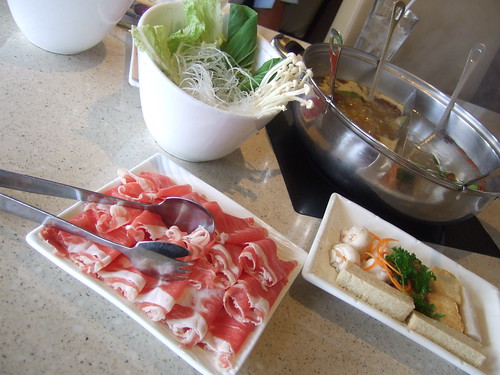
Hot Pot ingredients
We are healthy when our chi — energy — is in balance. Sickness is caused when our energy is out of balance, and traditional Chinese medicine prescribes various treatments to nudge our chi back in the right direction. Acupuncture, meditation, herbal remedies and food therapies are a few examples.
I think it's fair to say that Americans, in general, don't subscribe to the idea of chi. And if we did, it would be wildly out of balance, especially as it relates to food and nutrition. When we get sick, an obvious response would be to consume natural foods like fruits and vegetables (indeed, this is a tenet of traditional Chinese medicine) to restore balance and health. But in America, more often than not, we reach for a Z-Pak instead of an apple. Eating in general has become a competition to see how much food, regardless of its nutrition or restorative powers, we can shovel into our mouths. Regrettably, this competition is measured in rising rates of obesity and diabetes.
Read More...So be it. I'm not here to lecture you about how or what you should eat. There's enough lecturing going on in the media about how fat and lazy Americans have become. But I will make a pitch for adding some semblance of balance to our lives, especially when it comes to eating. One way to do that is to seek out those dishes which are by equal measures delicious, filling, nourishing and restorative for both mind and body. A perfect example of this type of dish is known as Chinese hot pot (huo guo). Also referred to as Chinese fondue, steamboat, Mongolian hot pot, or shabu-shabu (Japanese), "hot pot" is both a dish and an eating experience that encourages balance in how and what we eat.
First and foremost — energy, chi and balance aside — hot pot is a delicious and filling meal. But it takes some effort and knowledge to get the most out of it. I know what you're thinking: Americans don't like food that comes with a user manual. Furthermore, we don't like to go to a restaurant, spend our hard-earned money, and then have to cook the food ourselves. Fair enough. But with just a few tips and lessons, and a few trips to a hot pot restaurant, you'll come to understand why hot pot is an ingrained culinary tradition in many parts of the world, and why it is a healthy remedy to a diet of fast food in enormous portions.
Here's how hot pot works. You sit at a table which includes a heating element in the middle. In older restaurants, the heat source is an actual flame, often a propane burner. In the newer hot pot restaurants, an induction burner is used, where the heating element is cool to the touch but heats the pot through an electromagnetic current. In both cases, you have a control knob, like any stove top, to increase or decrease the level of heat.
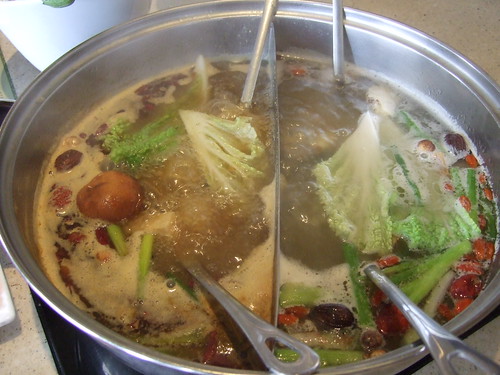
Vegetables are added to broth
Hot pot is made up of several basic elements: cooking broth, proteins (meat, seafood), noodles/tofu/mushrooms, vegetables, and dipping sauces. Your server will first ask you how spicy you want the broth to be. At its most basic, it could be "spicy" or "not spicy." The actual hot pot itself is partitioned into two separate containers, so it is normal to get one spicy and one not spicy. The broth-filled hot pot is then brought to the table and heated to a boil. The other (raw) ingredients are brought out, and everyone at the table chooses what ingredients they want to cook.
A typical self-cooking process might go like this: add some vegetables (baby bok choy, lettuce) and tofu or mushrooms to the broth to allow them to cook. Ladle some of the broth into your individual soup bowl. Use the strainer ladle to cook the cellophane noodles in the broth, then add that to your bowl. Now use the tongs to pick up a piece of the thinly-sliced meat and dredge it in the boiling broth. It cooks fast! For beef, cooking time may be only 5-10 seconds. Add the cooked meat to your bowl. Now fish out the cooked vegetables, tofu and mushrooms, and add those ingredients. Add a few drops of a dipping sauce and mix it in. Use chopsticks to eat the meat and vegetables, then drink the broth from your bowl.
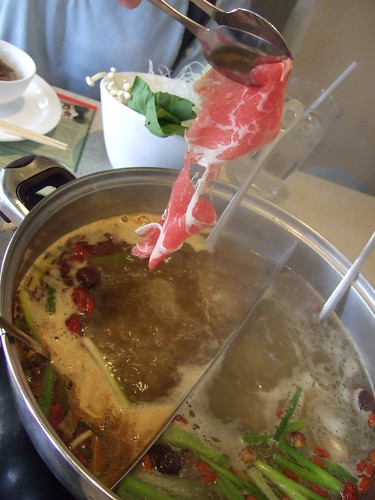
Meat about to be cooked in broth
The process and experience of hot pot is healthy on many different levels. First, the ingredients are supremely fresh and, for the most part, unprocessed. The broth itself is a fragrant, pungent concoction chock-full of Chinese herbs that are both delicious and associated with medicinal and restorative qualities: scallions, whole cloves of garlic, ginger, ginseng, wolfberry, red dates, black cardamom, fox nut, Sichuan peppercorns, to name a few. Also, the fact that you cook your own food in small quantities forces you to slow down and eat at a leisurely pace - there's no chance to shovel enormous portions of food into your mouth.
But there is also a spiritual, or more specifically social, aspect to hot pot. Traditionally you will share hot pot with a group of friends and/or family. The cooking procedure engenders lengthy meals, and thus time spent together. All kinds of conversation comes up as you slowly eat and drink; negotiations, queries, and goodwill offerings are part of the process: "Is that my bok choy?" "No, I put it in there a couple minutes ago, but you have it, I'll cook some more." The give-and-take, the cooperative cooking, the leisurely pace, and the inevitable laughing and conversation are undoubtedly restorative and good for our chi, such as it is, in both mind and body.
New hot pot restaurants:
Mongolian Hot Pot
Hot Pot City
Local Chinese restaurants with hot pot on the menu:
Sinh Sinh
Tan Tan
Other international hot pots:
Thai Tom Yum Hot Pot - Thai Spice Asian Bistro (Bellaire & Eldridge)
Shabu House (Japanese)
This blog entry was originally posted 27 October 2010 on the www.29-95.com website.
Subscribe to:
Posts (Atom)


 Posts
Posts

